Ablaze: Life in a Fire-Adapted Landscape

Updated: Dec 5, 2021
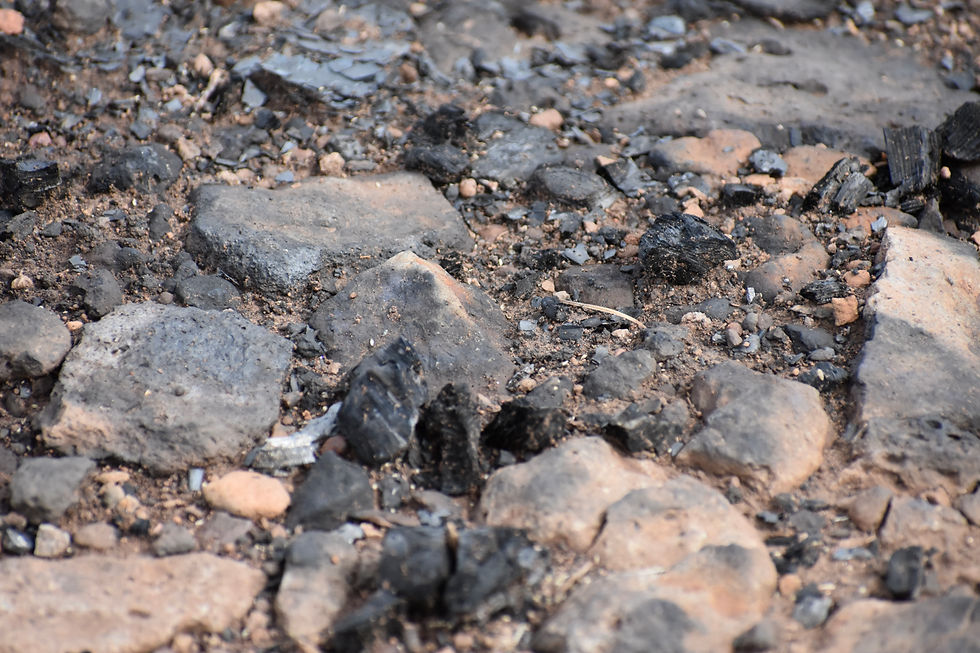
The forest was unnaturally silent. Once in a while, bird calls echoed distantly from the live parts of the forest. But the center of the burn scar was silent and seemed devoid of life. The trees were charred and brittle. Blackened flakes of bark hung off the trunks and littered the ground. Dead needles clung to the very tops of the pines; even the soil and rocks were blackened.

This is the Rafael Fire burn scar near Sedona, Arizona. The Rafael Fire, started by a lightning strike, burned 78,065 acres from mid-June to mid-July this past summer, according to the US Incident Information System.
In addition to lightning, sparks from equipment, cigarettes, arson and runaway or unattended campfires all contribute to the spread of wildfires, according to the National Park Service.
Though wildfires are typically seen as devastating natural disasters, historically they’ve been an integral component of the Northern Arizona landscape. Tayloe Dubay at the Northern Arizona University Ecological Restoration Institute, said that historically fire has acted like a predator. Before fire suppression started and cattle grazing and logging altered the structure and density of the forests, natural, low intensity lighting strike fires burned frequently through Arizona’s ponderosa pine forests. This thinned pine saplings which eased resource competition for larger trees, and reinvigorated grasses and wildflowers, maintaining the integrity of the forest.
“Frequent-fire forests of the Southwest, ponderosa pine predominantly, have evolved through millennia, millions of years, with fire,” said Dubay. But landscape alteration since Euro-American settlement has changed the entire ecosystem.
Today, ponderosa pine forests throughout Northern Arizona are much denser than they used to be. A combination of fire suppression and historical lack of thinning has created this situation, according to Dubay.
Dubay said fires are increasing in frequency, intensity and size. One contributing factor is drought. As temperatures rise globally due to climate change, Dubay said one of the consequences for Northern Arizona, as well as the larger Southwest region, is longer periods of drought.
Paul Oltrogge, wildland fire management officer for the City of Flagstaff, said that when the environment is stressed, it’s more prone to fire. Landscapes are experiencing longer periods of time without precipitation and as a result there’s less moisture in the environment. This stresses vegetation, making it less resistant to fire.
Not only are we seeing longer periods without precipitation, precipitation patterns are also changing, according to Jenny Neimann, the climate program manager for the City of Flagstaff. More time elapses between rain events, and when it finally does rain storms are becoming more intense and dumping a greater volume of water in a shorter period of time. This causes the water to run off more than soak into the soil.
In addition, intense heat interacts with the waxes and resins in vegetation to create a hard, water-resistant layer in the soil, according to Peter Fulé, fire ecologist at NAU’s School of Forestry. When these compounds are heated and then cooled, they coagulate underneath the soil, contributing to storm runoff.

Niemann explained that as the climate warms, snow patterns are also changing. A greater percentage of precipitation is falling as rain rather than snow due to warmer temperatures. This is a significant problem for the vast ponderosa pine forests of Northern Arizona because snow typically sits on the soil and soaks in slowly as it melts. The forests in this region have adapted to a slow infiltration process. However, increasingly intense rainstorms do not provide the deep and slow saturation that the trees need. This is an additional stressor for forests.
Though global climate change poses very real challenges for the Southwest, there are management techniques and preventative measures that can be implemented. Dubay said that restoring forest structure can restore its function. For example, thinning operations that restore forests to a more natural state create healthier ecosystems and allow for more natural growth. Forests produce healthier, larger trees that are better able to resist fire, and fires are less intense because the fuel is less dense.
Oltrogge said that the City of Flagstaff's wildland fire management program has spent a great deal of time, money and resources on mitigation efforts and building strong relationships with other levels of government and fire departments both within the state and federally.
Those relationships are crucial for effective fire management and prevention, said Oltrogge, because that cooperation allows for more effective communication and exchange of resources and skill sets for prevention and response efforts.
Oltogee said that the best way people living in a fire adapted landscape like Flagstaff can participate in the fire prevention process is to support mitigation efforts. Oltrogge said he understands why some issues like controlled burns may be controversial because community members don’t want to deal with smoke. But he explained that management efforts like controlled burns and thinning are necessary to prevent life-threatening fires, and that communication with the public is key to educating people on how important these efforts are.

Oltrogge said that the City invests in relationships with the community through face-to-face conversations with community members, town halls and maintaining up-to-date information on their social media accounts and government website pages. A productive way community members can take an active role in this relationship is following their local government on platforms such as Twitter and Facebook, attending town hall meetings and other information-disbursement events, staying informed from local news outlets and visiting their local government's website.
It’s clear that Flagstaff and similar landscapes throughout the Southwest will continue to deal with increasingly intense wildfires into the future. Critical decisions about forest management and where infrastructure is built need to be made. These decisions must include current knowledge but also an understanding of what this region will face in the future.
“We need to learn to live with fire,” said Dubay. “Fire is a natural part of living in the West.”
Living with fire is going to take community and local government cooperation, intentional forest management and conscious building placement to avoid the steep cost - both to property and life - of these infernos that have become our new normal.


Comments